
October Wires & Water Update: Virginia Takes Action — But Is It Keeping Pace?
Updated: Oct 10

Virginia’s response to data center growth shifted significantly in September.
Governor Abigail Spanberger announced a new statewide framework, communities continued tightening local rules, and regulators are looking more closely at who should pay for the power infrastructure needed to serve rapidly growing demand.
At the same time, development continues. A proposed data center campus in nearby Amherst County brings the issue much closer to Nelson, while the infrastructure supporting AI is reaching an extraordinary scale.
This month, the question is becoming less about whether Virginia is taking action and more about whether that action can keep pace with what is already being planned and built.
IN THIS UPDATE
Closer to Home
Data Center Development Moves Closer to Nelson
A proposed data center campus in Madison Heights, Amherst County, brings the issue considerably closer to Nelson.

Developer Old Dominion Capital Partners has proposed a 93-acre campus behind the former Big Lots on Business 29, with plans showing five data center buildings and an electrical substation.
The proposal arrived just as Amherst County changed how it reviews data centers. Supervisors voted in August to require future projects to obtain a Special Use Permit, meaning individual proposals would go through public review rather than being allowed by right.
Amherst officials later determined the Madison Heights application was incomplete, meaning any resubmission would be subject to the county’s new Special Use Permit process.
THE STORY IN NUMBERS 40 acres ≈ 30 football fields That’s roughly the portion of the Madison Heights site proposed for development — a more tangible way to picture the project’s physical footprint. Source: WSET ABC 13, Lynchburg |
Why This Matters for Nelson County: Last month we looked at the advantage Nelson has in establishing rules before a project arrives. Amherst shows how quickly that preparation can become relevant. A proposal can move from hypothetical to real while zoning rules are still being debated. Nelson, meanwhile, is still updating its own Zoning and Subdivision Ordinance, which for the first time includes specific provisions for data centers. For more details, check out our Friends of Nelson review of the proposed changes. There is still time to provide feedback.
Read More:
Virginia Takes Action — and Local Governments Aren’t Waiting
A New Statewide Framework
On September 18, Governor Abigail Spanberger announced a Data Center Accountability Framework and signed Executive Order 22.
The order immediately directs state agencies to limit nondisclosure agreements that conceal information about data center projects, develop a community-engagement toolkit for localities, accelerate work on noise regulations, review backup generation and water impacts, and examine lower-impact locations for future development. It also creates a new AI Task Force.
Other parts of Spanberger’s framework require legislation. Those include requiring local approval for data centers using more than 25 megawatts (25 MW is about the electricity use of roughly 20,000 homes), stronger environmental standards, limits on some on-site natural gas generation and policies intended to shift more infrastructure costs toward the large electricity users driving them.
The framework does not pause data center development. Environmental and community groups have continued calling for a statewide moratorium while new protections are developed, while business groups have cautioned against policies they say could discourage investment.
Local Governments Move Ahead
Communities are also changing their own rules. Prince William County moved to substantially reduce where data centers can continue to develop by right. Other Virginia localities have adopted or considered special-use requirements, tighter zoning standards and temporary pauses.
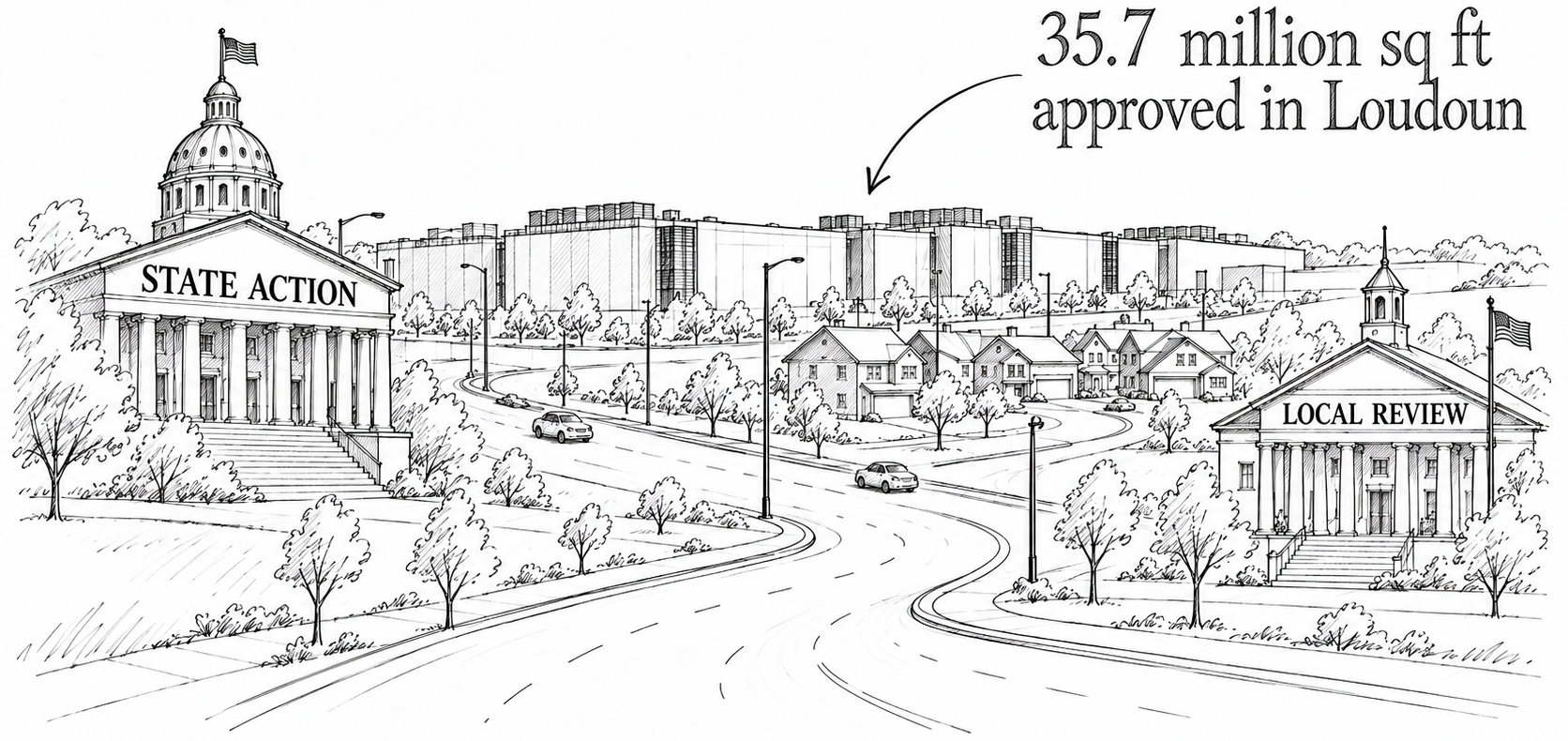
In Loudoun County, supervisors are considering a policy that could delay the Board’s final vote on certain data center and substation applications for up to 12 months while the county reviews its regulations. Applications could still move through parts of the review process during that time, but the Board would hold off on approving or denying them. This is not a blanket moratorium: Loudoun’s county attorney concluded that such a moratorium would not be legally permissible under Virginia’s zoning laws, so the county is considering this more limited pause instead. A final vote on the policy is scheduled for October 20.
The difficulty is that new rules generally cannot undo development already approved.
CONSIDER THIS 35.7 million square feet ≈ 620 football fields That is how much data center development Loudoun County says has already been approved but not yet built. Source: Loudoun County, “Data Centers: The Loudoun Story” |
Why This Matters for Nelson County: State policy can establish broader protections, but local zoning still determines many of the most immediate questions about where projects can go and how the public participates.
Read More:
Energy & Transmission
Who Pays for the Buildout?
As electricity demand from data centers grows, regulators are increasingly asking not only how to build enough power infrastructure, but who should pay for it.
Virginia regulators have already taken steps toward assigning more transmission costs directly to very large electricity users. Microsoft, one of the companies affected, has already taken the first legal step toward a possible appeal.
Federal regulators have directed PJM, which manages Virginia’s regional electric grid, to reconsider how costs for large new users should be allocated. On September 29, federal regulators directed PJM to revise a plan intended to secure additional generation as electricity supplies tighten. FERC commissioners emphasized that customers driving new costs should bear an appropriate share rather than shifting those costs to existing customers.
North Carolina regulators recently raised a related concern when they declined, for now, to approve Duke Energy’s proposed $584 million gas turbine. Duke said the plant was needed partly because of projected data center growth. Regulators concluded that much of that demand remained too uncertain to justify the investment yet.

Why This Matters for Nelson County: Nelson does not need to host a data center to experience the effects of data center growth. New transmission lines, substations, generation and electricity costs can extend far beyond the communities where the facilities themselves are located.
Read More:
Property & Community Impacts
What Happens to Nearby Home Values?
A new working paper from researchers affiliated with the Energy Institute at Haas examines housing prices around newly announced large data centers.

The researchers estimate that home values within three miles declined by about 3% on average over the following five years, with the largest effects closest to the facility. The effect was strongest when the data center was the first large facility of its kind in the area.
THE STORY IN NUMBERS 7.2% within 1 mile • 3% within 3 miles For a $400,000 home, that would equal about $29,000 and $12,000 in estimated lost value, respectively. Source: Energy Institute at Haas |
The researchers estimate the effects amount to about $20.6 billion in housing wealth nationally.
One important qualifier: this is a working paper and has not yet been peer-reviewed.
Why This Matters for Nelson County: Property values are frequently raised when large projects are proposed, but evidence has been limited. This research adds useful data while reinforcing that distance, facility size and local conditions matter.
Read More:
Wires & Water & Watson
AI & The Infrastructure Behind It
AI can feel almost weightless: type a question into a screen and an answer appears seconds later.
The infrastructure behind that answer is anything but.

Elon Musk’s xAI operates Colossus, the computing infrastructure behind Grok, in the Memphis area. The company has said it ultimately wants to operate as many as 1 million GPUs.
What does that actually mean?
GROK THIS 1 million GPUs ≈ electricity used by roughly 560,000 – 800,000 homes That estimate covers only the power used directly by the GPUs themselves when they are working at maximum power. It does not include cooling, CPUs, memory, networking, storage or other building systems — so the total facility demand would be higher. 1 million square feet ≈ about 17 football fields of floor space The scale helps explain why the AI race increasingly means a race to build power generation, transmission, water systems and enormous physical facilities. Sources: xAI, NVIDIA, Washington Post and Data Center Dynamics |
And xAI may soon be eclipsed: Meta’s Hyperion campus in rural Louisiana is planned for 5 gigawatts of capacity — substaintially larger than xAI’s expanding Memphis-area buildout, which includes Colossus.
For a striking sense of scale, visit The Washington Post article itself — its satellite-image comparisons make the size of these projects much easier to grasp than numbers alone.
These are just two examples. The Washington Post recently identified nearly 100 hyperscale data centers already operating in the United States, another 120 under construction and roughly 460 more planned.
That scale is also transforming land. In the Post’s analysis of 93 large U.S. facilities, only about 40% were built on previously developed land, while roughly a third replaced farmland.
Why This Matters for Nelson County: The growth of AI is not simply a technology story. Increasing computing demand has a physical footprint — and decisions about where that infrastructure goes determine which communities experience its land, water and energy impacts. It also raises a broader policy question: how should AI use be governed when its benefits and infrastructure costs are increasingly shared across society?
Read More:
A personal aside: I was mildly offended on behalf of the world when Elon Musk chose such an iconic word and repurposed it for his AI system. Grok was coined by Robert A. Heinlein in Stranger in a Strange Land to mean understanding something deeply and intuitively. There’s a certain irony in the word now being tied to infrastructure that is so massive, physical and resource-intensive. Although, in Heinlein’s invented Martian language, grok literally means “to drink” — so given AI’s growing water footprint, I suppose the name is, regrettably, rather apt. |
What You Can Do
Help Shape Nelson County’s Zoning Rules: See the draft and find upcoming ways to participate.
There are several ways to get involved, depending on how much time you want to give — from simply reading the draft or sending an email to attending a public meeting or speaking during a hearing.
Email the Nelson County Board of Supervisors:
Jesse Rutherford, East District — jrutherford@nelsoncounty.org
David Parr, West District — dparr@nelsoncounty.org
Cameron Lenahan, North District — clenahan@nelsoncounty.org
Ernie Reed, Central District — ereed@nelsoncounty.org
Jessica Ligon, South District — jligon@nelsoncounty.org
Not sure where to start? Begin with our review of Nelson County’s proposed data center rules and the questions residents may want to consider before the ordinance is finalized.
Follow the statewide moratorium campaign. March for a Moratorium events are scheduled across Virginia October 10–24.
Tell state leaders what you want to see in Virginia’s data center rules. Many parts of the Governor’s framework still require General Assembly action. Find your state delegate and senator and contact them by email or phone, or contact Governor Spanberger at Abigail.Spanberger@governor.virginia.gov or 804-786-2211.
Learn More
Nature Forward offers a seven-session, self-guided course on data center impacts and ways communities can advocate for more responsible development.
Explore JLARC’s Data Centers in Virginia study, one of the most comprehensive independent reviews of electricity demand, costs, water, land use, noise and other impacts in the Commonwealth.
Explore DEQ’s data center information, including information on air quality, permitting and its Northern Virginia data center monitoring project.
New this month: Read about Virginia’s new Data Center Accountability Framework and what may come before the General Assembly next.
Looking Ahead
September brought something Virginia’s data center debate has been missing: more concrete action.
The state has proposed broader rules. Local governments are tightening zoning. Regulators are reconsidering who pays for infrastructure. And communities are asking increasingly detailed questions about water, land, housing and transparency.
But the buildout continues at the same time.
That is the tension to watch now: whether new protections can take effect quickly enough to meaningfully shape the projects and infrastructure already moving through the pipeline.
For Nelson, the Madison Heights proposal makes that question less theoretical. Establishing clear rules now gives the county an opportunity to decide how it wants to approach these projects before one arrives at its own doorstep.
YOUR TURN What should Nelson County’s data center rules protect most? Tell us in the comments. We would love to hear from you! |
Wires & Waters Update by Erin Palmquist for Friends of Nelson
Have a question, story or issue you think we should cover? Email Erin at WiresAndWaterUpdate@gmail.com.
About the Wires & Water Updates
I established Wires & Water when the Friends of Nelson board recognized that residents wanted more information about data center development. I took it on because I care deeply about Nelson’s rural landscape and natural resources, and about residents having a meaningful voice in decisions that could affect them. Virginia — and increasingly our region — is on the precipice of significant change as data centers, AI and the infrastructure needed to support them expand. I believe this is an important time to understand what is happening, ask questions and help shape that change rather than simply react to it later.
These updates draw on reporting from local, state and national news organizations, public records, government and regulatory sources, research organizations, newsletters including Data Center Watch, internet research, and AI-assisted research and drafting tools.
A note about my use of AI: My use is intentional, as is my interest in examining its impacts. AI is an extraordinarily valuable tool that I use throughout the development of Wires & Water to help synthesize a large volume of information. Accompanying illustrations are AI-assisted, shaped through my own concepts, prompts and creative direction.
At the same time, I believe AI’s rapid growth raises urgent questions about ethics, accountability, resource consumption, and the environmental and community impacts of the data centers that support it. Slowing the pace of data center development may give communities and policymakers time to establish appropriate safeguards and make more informed choices about how this rapidly evolving technology expands.

Comments